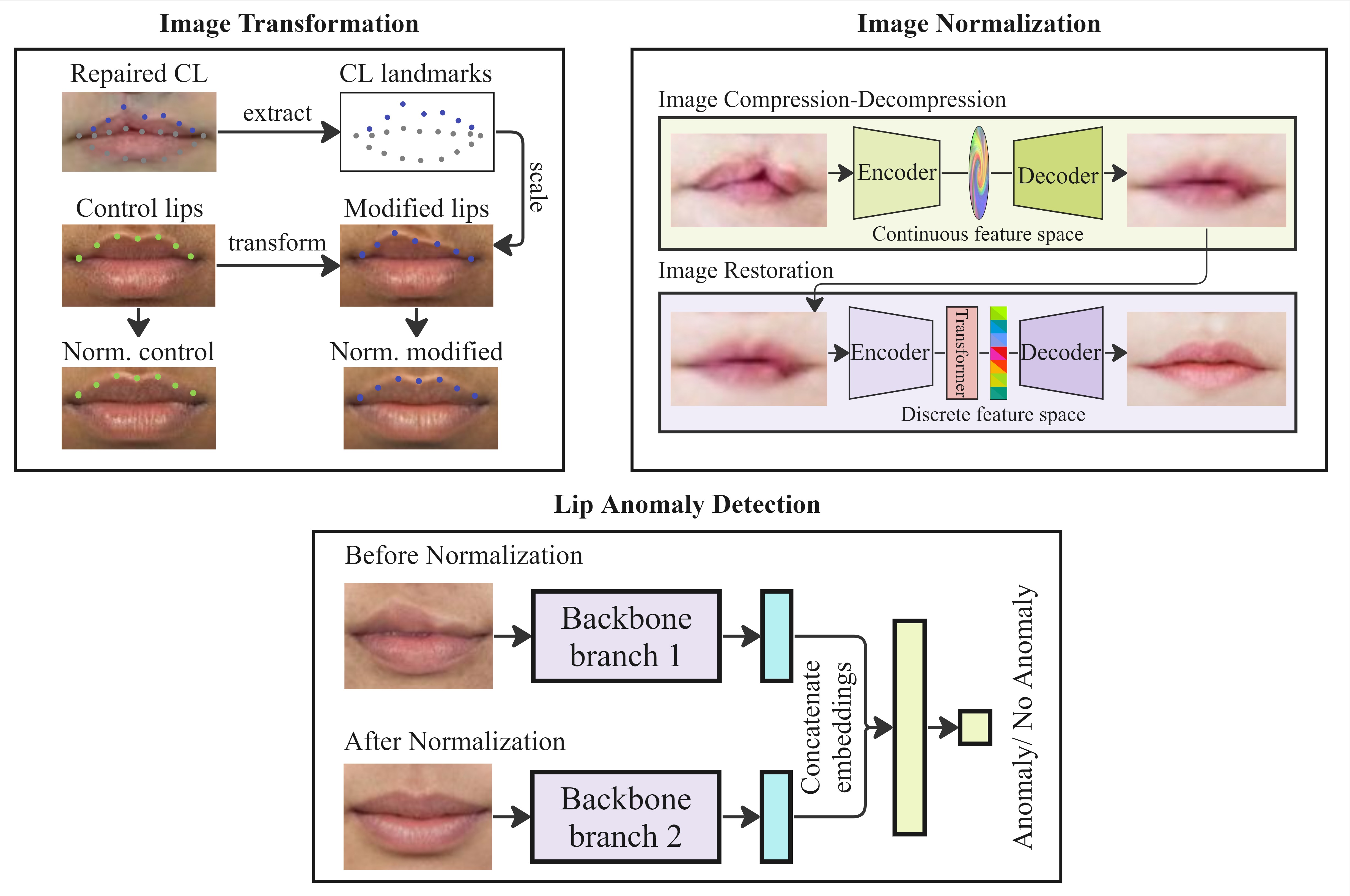
Abstract: The cleft lip condition arises from the incomplete fusion of oral and labial structures during fetal development, impacting vital functions. After surgical closure, patients commonly present with abnormal lip shape, which may require secondary revision surgery for both aesthetic and functional improvement. However, a lack of standardized evaluation methods complicates decision-making for secondary surgery. To address this limitation, we propose a transformer-based lips normalization approach that filters out abnormalities and achieves a standardized appearance while preserving individual anatomy. An innovation of our approach is a lip transformation method using available face datasets to mimic repaired cleft lip shapes, enabling the training of deep learning models without using patients' data. We employ a Siamese convolutional neural network that processes pre- and post-normalization images to detect lip abnormalities with an accuracy of 88.10%. We compare our approach with a single-branch model without lips normalization, which reached an accuracy of 65.80%. Our approach has the potential to provide an impartial view to determine the need for revision surgery while also assisting in the selection of healthcare tools specialized for patients with repaired cleft lip.
The code for this work is available in our official repository.